Analysis
Jungle Bungle
Published July 06, 2026 | 5 min read

This article was updated on July 7
Five weeks after the death of the most celebrated pachyderm since Jumbo of Ringling Brothers fame, city lawmakers are moving to ban elephant captivity in New York City.
And that could present a fresh legal challenge for the Bronx Zoo, where Happy the elephant lived for 53 years, mostly in isolation, amid a decade of clamoring for her to be sent to a wildlife sanctuary and court fights involving the zoo’s parent company, the Wildlife Conservation Society.
After Happy was euthanized on May 26, her handlers said she had inoperative uterine tumors and declining kidney and liver function and died peacefully. The zoo was left with one elephant, Patty, who is 57.

Happy’s death has spurred support for a New York City Council bill that would make it illegal to keep or hold an elephant in the five boroughs unless “adequate habitat and treatment” were provided. Lead sponsor Shahana Hanif of Brooklyn, who proposed a similar measure in 2023, has 10 co-sponsors.
“We’re framing it as Happy’s Law,” said Courtney Fern, director of campaigns for the Nonhuman Rights Project, which sued the WCS to free Happy in 2018. She said the City Council measure amounts to a total ban on elephants in New York as there are no animal sanctuaries in the city capable of caring for the animals.
“We want the Bronx Zoo to do the right thing, which is to get Patty to a sanctuary,” Fern said. “An elephant shouldn’t be alone. And Patty is truly alone. Our goal is for no other elephant to endure that.”
On July 6 The Gothamist reported that WCS officials visited a 3,000-acre elephant sanctuary in Tennessee in June and are weighing whether to send Patty there.
“We want to make sure that we feel that it would be the right move for her, and the risks would be outweighed by the potential gains,” Bronx Zoo interim director Craig Piper told the news outlet.
The plight of Happy, who was hailed for proving elephants were self-aware but shunned by the zoo’s other two elephants after they killed her lifelong companion, was exposed in this reporter’s investigative story in 2012.
NhRP cited the piece in its lawsuit, which claimed elephants were entitled to the same habeas corpus protections as people and that Happy had been “unlawfully imprisoned.” That prompted national coverage of Happy and scrutiny of the Wildlife Conservation Society, which runs the zoo.
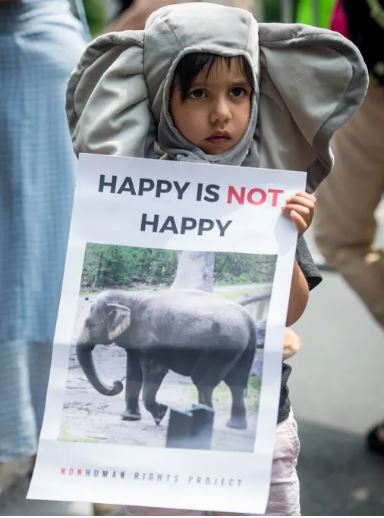
WCS prevailed in 2022, winning a 5-2 decision in the New York Court of Appeals, which ruled that anti-confinement laws didn’t apply to elephants.
Piper slammed the suit in a statement last month.
“Happy was the subject of years of frivolous litigation brought by anti-zoo activists seeking to have her legally declared a person and removed from the Bronx Zoo. In multiple rulings, New York State courts, including the state’s highest court, ruled in favor of the Bronx Zoo.”
But WCS also has been the subject of an abuse investigation, leading to millions in funding being pulled, and lost a class-action lawsuit.
An investigation by Survival International — an NGO that advocates for the rights of indigenous people — alleged in 2017 that the WCS funded violence against the Bayaka and other rainforest tribes in the Republic of Congo.
The Society allegedly created a national park on Bayaka land without the group’s consent, and has supported anti-poaching squads to keep them out, with “dozens of instances of harassment, beatings and even torture,” Survival International claimed.
“The Bayaka are frequently accused of ‘poaching’ when they hunt to feed their families,” it alleged. “Tribal people have complained that this diverts action away from tackling the true poachers – criminals conspiring with corrupt officials.”
In 2023, the French development agency AFD pulled more than $12 million in funding from WCS and the World Wildlife Fund after investigators allegedly found that at least 20 Batwa people were killed and 30 sexually assaulted in the Kahuzi-Biega national park in the Congo between 2019 and 2021.
Last year the WSC forked over $990,000 to settle a class action lawsuit in Manhattan federal court, led by plaintiff Nicole Patterson, who alleged that she and others got ripped off when the zoo charged a $2 hidden processing fee to online ticket buyers, a violation of state law.
The suit claimed that WCS violated New York’s Arts and Cultural Affairs Law, which requires venues to disclose the total cost of a ticket before processing a purchase. WCS agreed to revise its ticketing on BronxZoo.com to comply with the law.
In addition to ordering WCS to compensate Patterson and others, Judge Jesse M. Furman awarded them $330,000 in legal fees in a final hearing on June 5 2025 in Manhattan federal court.